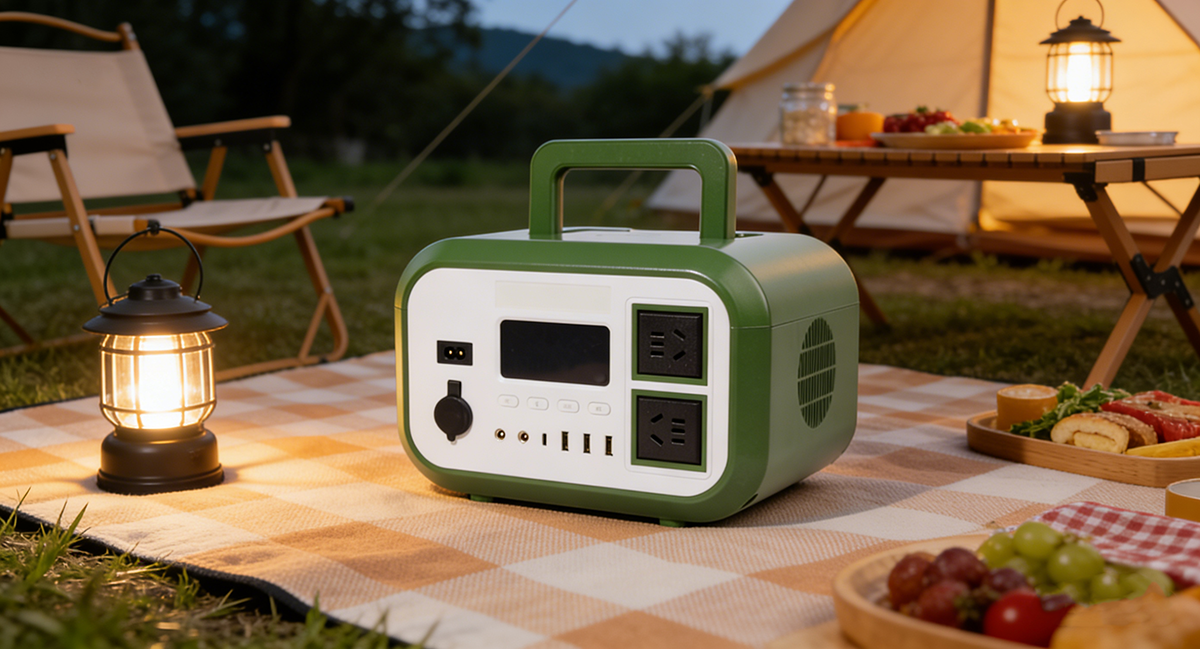
The core principle of portable power supply (also known as outdoor power supply and portable energy storage power supply) is: firstly, external electric energy (commercial power, solar energy, etc.) is converted into chemical energy and stored in lithium batteries, and then the chemical energy is converted into stable alternating current and direct current to output to equipment when necessary, which is essentially a closed-loop system of "electric energy storage and conversion".
I. Core component modules
A complete portable power supply consists of four core circuits and battery cells:
Battery pack (energy storage unit)
Mainstream: Ferrous lithium phosphate or ternary lithium batteries, which are connected in series and in parallel to form 12V/24V/48V high-voltage battery packs.
Function: It stores electric energy in the form of chemical energy and is the "energy warehouse" of power supply.
BMS battery management system (protecting brain)
Monitor the voltage, current and temperature of each power saving core in real time.
Core functions: overcharge protection, overdischarge protection, overcurrent protection, short circuit protection and battery balance.
AC-DC charging module (mains charging)
Rectify, step down and stabilize the 220V household alternating current, and convert it into a battery-acceptable direct current (such as 12V/24V).
Support: mains charging, vehicle charging and solar MPPT fast charging.
DC-DC buck-boost module (DC output)
Convert the low-voltage DC (such as 12V) of the battery into 5V/9V/12V and other DC voltages.
Supply: USB, Type-C, DC round hole, car charging port, etc.
DC-AC inverter (AC output)
Invert the low-voltage DC of the battery into 220V/110V power frequency AC.
Supply: Notebooks, rice cookers, mini refrigerators and other household appliances.
Second, the complete workflow
1. Charging stage (electric energy → chemical energy)
Commercial power charging: 220V AC → AC-DC module → step-down and voltage stabilization to DC (such as 24V)→ BMS control → charging lithium battery in constant current/constant voltage mode.
Solar charging: photovoltaic panel → direct current → MPPT controller → maximum power tracking → efficient charging of battery.
Charging logic: pre-charging → constant current fast charging → constant voltage Wally → trickle floating charging.
2. Discharge/power supply stage (chemical energy → available electric energy)
The battery outputs low-voltage DC (12V/24V)→ checked by BMS.
DC output path:
Battery DC → DC-DC buck → 5V USB/9V/12V DC output.
Support PD fast charge (20V) to directly supply power to the notebook.
Ac output path:
Battery DC → DC-AC inverter → 220V/50Hz sine wave AC inverter → AC outlet output.
Third, the key technical principles
DC-DC step-up/down: Using MOS tube high-frequency switch (hundreds of kHz), with inductor and capacitor energy storage filtering, accurate voltage step-up and step-down can be realized.
DC-AC inverter:
High-frequency SPWM pulse width modulation → driving IGBT/MOS tube to conduct alternately.
Generate high frequency square wave → filter by LC → output pure sine wave AC.
BMS balance: automatically balance the voltage of each series battery cell to prevent excessive pressure difference and improve life and safety.
IV. Overview of Energy Conversion
Charging: external electric energy (AC/photovoltaic DC)→ AC-DC/MPPT → battery (chemical energy).
Discharge: battery (chemical energy) → DC-DC → low voltage DC output.
Discharge: battery (chemical energy) → DC-AC → 220V AC output.
Simply put, portable power supply is a "mobile lithium battery energy storage station" with inverter, step-up and step-down and multiple protection.


